
Refractor vs Reflector vs Schmidt-Cassegrain: Which Telescope Type?
EyepieceLab is reader-supported. If you buy through our links we may earn a commission at no extra cost to you. As an Amazon Associate we earn from qualifying purchases. Disclosure.
Every telescope does the same job, gathering light and focusing it, but there are three common ways to do it. Definitions below are from Celestron's astronomy glossary.
Side by side
| Refractor | Newtonian reflector | Schmidt-Cassegrain | |
|---|---|---|---|
| How it works | Front lens focuses light straight back to the eyepiece | Primary mirror at the back; small flat secondary sends light out the side | Corrector lens plus two mirrors fold the light path |
| Upkeep | No mirrors to align | Occasional collimation (Celestron) | Collimation per maker; Maksutovs never need it (Celestron) |
| Aperture for the money | Less than a Dob (Sky-Watcher) | Highest, for Dobsonians (Sky-Watcher) | Less than a Dob (Sky-Watcher) |
| Size | Long tube | Long tube | Short, compact tube |
| Typical mount | Alt-az tripod | Dobsonian or equatorial | GoTo fork or equatorial |
| Daytime use | Easy with an erect-image diagonal | Awkward (image is flipped) | Possible with a diagonal |
Refractors
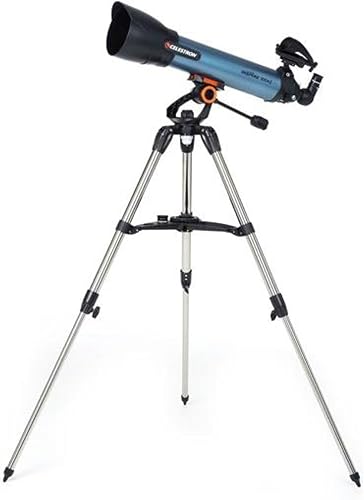
Celestron describes the light passing "in a straight line from the front objective lens directly to the eyepiece." Sealed tube, no mirrors to align. The catch is cost per inch: a 100 mm refractor is a mid-size telescope, while 100 mm is a small reflector. See refractor telescopes.
Celestron Inspire 100AZ
- 100 mm refractor (per Celestron) with erect-image optics
- Lens cap doubles as a smartphone adapter, per the listing
- Red LED flashlight stored in the mount head
- Folding accessory tray
Newtonian reflectors
A concave primary mirror "collects and focuses incoming light onto a flat secondary (diagonal) mirror," which reflects it "to an eyepiece on the side of the optical tube," per Celestron. Sky-Watcher says Dobsonians give "the highest possible aperture for their money" compared with Schmidt-Cassegrains or refractors. And aperture matters: Tele Vue's Al Nagler wrote that for faint galaxies and clusters "there is no substitute for aperture." The cost is collimation now and then.
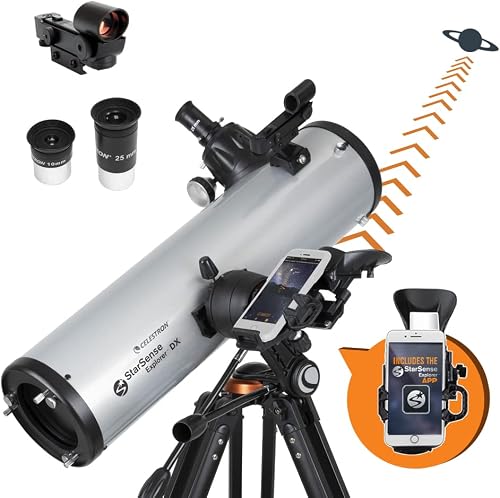
Celestron StarSense Explorer DX 130AZ
- 130 mm (5 in.) Newtonian reflector, per the listing
- Phone dock + StarSense app points you to targets with on-screen arrows
- Manual alt-azimuth mount with dual-axis slow-motion controls
- 2-year US warranty
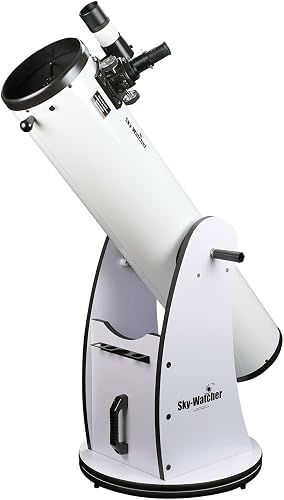
Sky-Watcher Classic 200 Dobsonian (8 in.)
- 8 in. solid-tube Dobsonian, per the listing
- 2 in. Crayford focuser with 1.25 in. adapter
- 25 mm and 10 mm eyepieces; 9x50 finder
- About 45 lb assembled (20 lb tube, 25 lb base)
Schmidt-Cassegrains (and Maksutovs)
Light enters through a thin corrector lens, bounces off the primary mirror to a convex secondary, then goes back out through a hole in the primary to the eyepiece, per Celestron. The result is a big aperture in a short tube. Celestron says the related Maksutov-Cassegrain design "never needs to be collimated."
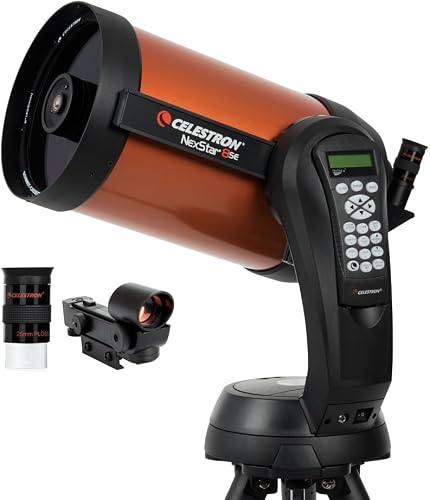
Celestron NexStar 8SE
- 8 in. Schmidt-Cassegrain optics, per the listing
- Computerized GoTo mount with NexStar+ hand control; 40,000+ object database
- SkyAlign: center any three bright objects to align
- 2-year US warranty
Which should you pick?
- Want the most to see for the money: a reflector, ideally a Dobsonian.
- Want simple and low-maintenance, or daytime use too: a refractor.
- Want compact with GoTo: a Schmidt-Cassegrain like the NexStar SE.
FAQ
Refractor vs reflector?
Lens up front vs mirror at the back.
Which needs more maintenance?
Newtonian reflectors.
What's a Schmidt-Cassegrain?
A folded mirror-and-lens design in a short tube.