
What Can You Actually See With a Telescope?
EyepieceLab is reader-supported. If you buy through our links we may earn a commission at no extra cost to you. As an Amazon Associate we earn from qualifying purchases. Disclosure.
Setting expectations is the best thing you can do for a new telescope owner. Here's what NASA says you can see with different gear, and what changes it.
By instrument
Binoculars (7x35 to 10x50)
NASA's Night Sky Network: the Moon (craters down to about 6 miles across), "large open star clusters like the Pleiades (M45), and, from dark skies, larger bright galaxies like the Andromeda Galaxy (M31) and large nebulae like the Orion Nebula (M42)." You may spot Jupiter's moons, but likely not Saturn's rings. See astronomy binoculars.
A small telescope
NASA's skywatching FAQ: binoculars or a small telescope make visible "the large moons of Jupiter and the rings of Saturn, as well as star clusters and double stars." NASA's Jupiter notes add that small telescopes show all four Galilean moons, when all are visible, and cloud bands, and, "if powerful enough," the Great Red Spot.
A larger telescope
NASA: "A larger telescope enables you to see fainter objects, like nebulas and other galaxies." That's where an 8 inch Dobsonian shines.
The Messier list: a ready-made target list
Charles Messier's catalog of 110 objects is, per NASA, a set of "nice targets for backyard astronomers with a pair of binoculars or a small telescope and a relatively dark sky." NASA's Hubble Messier catalog has a page and star chart for each one.
What changes the view
- Light pollution. DarkSky International says 80% of the world lives under sky glow, and 99% of people in the U.S. and Europe can't experience a natural night. On the Bortle scale (summarized by the University of Montana), in suburban-to-urban skies "the brightest Messier objects are only ghosts of their true selves," while inner-city skies leave mainly "the Moon, the Planets, and a few of the brightest star clusters."
- Timing. NASA says outer planets are best near opposition. NASA's What's Up for October 2026 lists Saturn at opposition on October 4.
- Your eyes. Give them 20 to 40 minutes to dark-adapt (National Park Service) and use averted vision for faint objects.
A note on photos
The colorful images you see online are long-exposure photographs, and by eye galaxies and nebulae are much fainter. If you want that kind of image, look at smart telescopes or a star tracker.
Gear that matches these targets
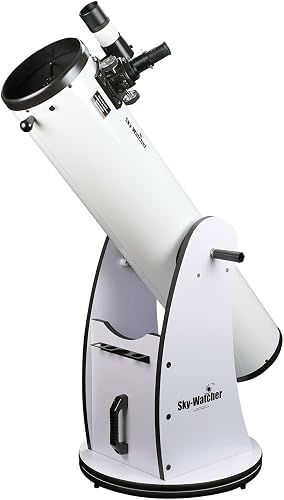
Sky-Watcher Classic 200 Dobsonian (8 in.)
- 8 in. solid-tube Dobsonian, per the listing
- 2 in. Crayford focuser with 1.25 in. adapter
- 25 mm and 10 mm eyepieces; 9x50 finder
- About 45 lb assembled (20 lb tube, 25 lb base)
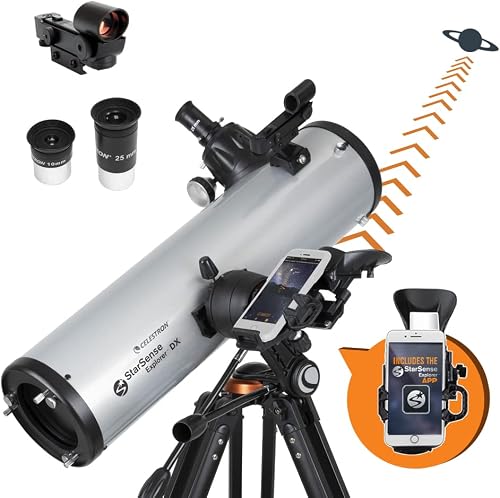
Celestron StarSense Explorer DX 130AZ
- 130 mm (5 in.) Newtonian reflector, per the listing
- Phone dock + StarSense app points you to targets with on-screen arrows
- Manual alt-azimuth mount with dual-axis slow-motion controls
- 2-year US warranty
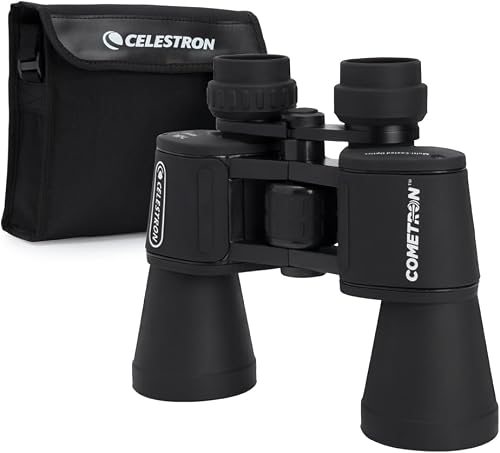
Celestron Cometron 7x50 Binoculars
- 7x magnification, 50 mm objectives, per the listing
- 6.6° field of view
- Tripod-adaptable (adapter not included)
More in telescopes for beginners and telescopes for planets.
FAQ
Saturn's rings in a small scope?
Yes, per NASA.
Galaxies?
Yes, faintly; dark skies help.
Hubble-like views?
No; those images are long exposures.