
Telescopes for Beginners: What Actually Matters, and the Models Worth a Look
EyepieceLab is reader-supported. If you buy through our links we may earn a commission at no extra cost to you. As an Amazon Associate we earn from qualifying purchases. Disclosure.
Your first telescope is mostly about two things: how much light it collects, and whether it's easy enough to set up that you'll actually use it on a Tuesday night. Everything below comes from Celestron's and Sky-Watcher's official spec pages and the Amazon listings. We haven't tested these scopes.
What actually matters
- Aperture. Celestron's glossary says light gathering is "directly proportional to the square of the aperture," and aperture sets maximum resolution. A 130 mm mirror collects about 69% more light than a 100 mm lens (130² vs 100²), which is why bigger reflectors show fainter things.
- The mount. Alt-azimuth mounts move up-down and left-right, which is intuitive. Equatorial mounts tilt one axis to match Earth's rotation, per Celestron's glossary, which also describes the Dobsonian's "rocker box" mount as "more simplistic."
- Useful magnification. Celestron puts the ceiling at about 60x per inch of aperture. Past that, "the image will be magnified but will not carry or enhance any more details." A 70 mm scope advertising 500x is a red flag.
- Weight and setup. A scope that's a chore to haul out tends to stay inside. Celestron lists total kit weights below, so you can judge.
The starters, side by side
| Telescope | Type | Aperture / focal length | Mount | Kit weight |
|---|---|---|---|---|
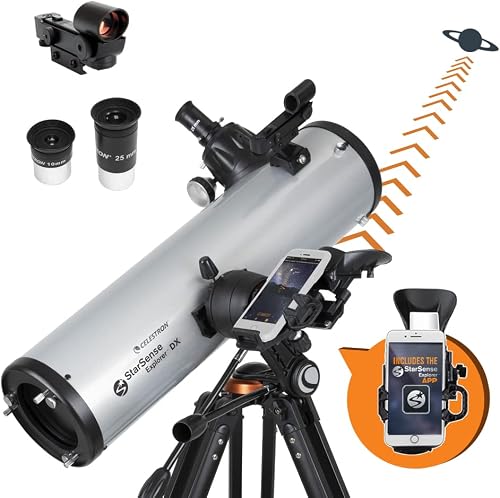
| StarSense Explorer DX 130AZ | Reflector (parabolic) | 130 mm / 650 mm, f/5 | Manual alt-az + phone app | 18 lb |
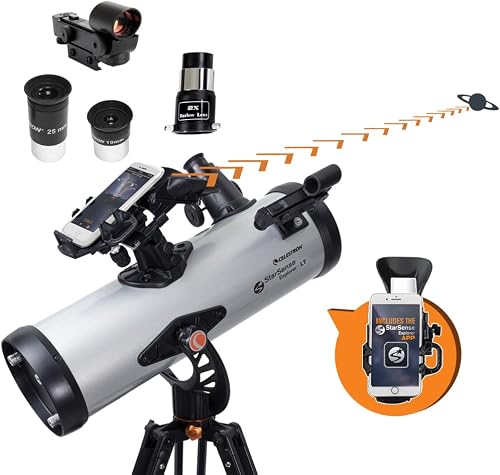
| StarSense Explorer LT 114AZ | Reflector (spherical) | 114 mm / 1000 mm, f/9 | Manual alt-az + phone app | 10.4 lb |
| AstroMaster 130EQ | Reflector (spherical) | 130 mm / 650 mm, f/5 | CG-3 equatorial | 17 lb |
| Inspire 100AZ | Refractor | 100 mm / 660 mm, f/6.5 | Manual alt-az | 12.4 lb |
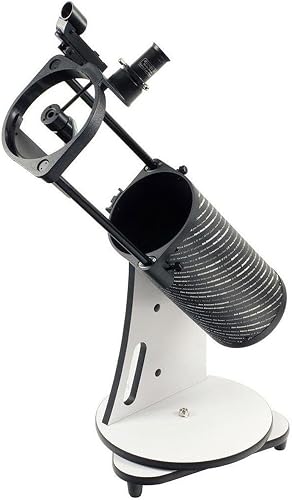
| Sky-Watcher Heritage 130 | Reflector (parabolic) | 130 mm / 650 mm, f/5 | Tabletop Dobsonian | 13.3 lb |
Celestron figures are from its spec pages; Heritage figures are from Sky-Watcher USA's product sheet.
If you want help finding things: StarSense Explorer
The hardest part of a first telescope isn't seeing, it's finding. The StarSense Explorer line docks your phone on the scope, and the app uses the stars overhead to work out where you're pointed, then shows arrows to your target, per the listing. The DX 130AZ has a parabolic 130 mm mirror; the lighter LT 114AZ has a spherical 114 mm mirror at f/9 and includes a 2x Barlow, per Celestron's specs.
Celestron StarSense Explorer DX 130AZ
- 130 mm (5 in.) Newtonian reflector, per the listing
- Phone dock + StarSense app points you to targets with on-screen arrows
- Manual alt-azimuth mount with dual-axis slow-motion controls
- 2-year US warranty
Celestron StarSense Explorer LT 114AZ
- 114 mm (4.5 in.) Newtonian reflector, per the listing
- Phone dock + StarSense app sky recognition
- Manual alt-azimuth mount with altitude slow-motion rod
- 2-year US warranty
Torn between them? See StarSense DX 130AZ vs LT 114AZ.
If you want grab-and-go: a tabletop Dobsonian
The Heritage 130 arrives fully assembled, per the listing, and collapses to 14 inches long, per Sky-Watcher's sheet. You'll need a sturdy table or stool to set it on.
Sky-Watcher Heritage 130mm Tabletop Dobsonian
- 130 mm collapsible tabletop Dobsonian, per the listing
- Arrives fully assembled
- 10 mm and 25 mm eyepieces; starpointer finder
- 2-year warranty
Celestron StarSense Explorer 130mm Tabletop
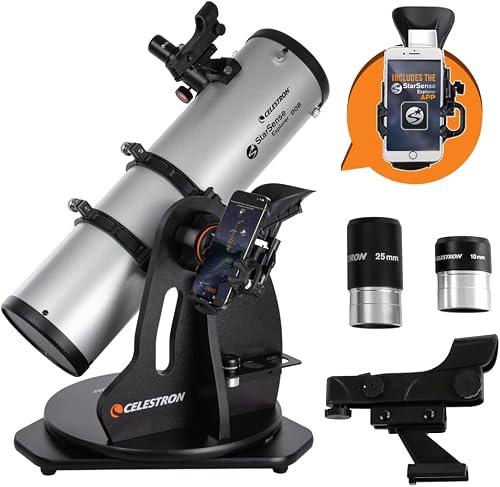
- 130 mm (5 in.) Newtonian reflector, per the listing
- Tabletop Dobsonian-style base
- Phone dock + StarSense app
If you want to learn the classic way: AstroMaster 130EQ
An equatorial mount with slow-motion knobs for right ascension and declination, per the listing. It takes a little learning to polar-align, but once you do, following an object is a one-knob job. Celestron uses this exact scope as its worked example for useful magnification: 307x maximum, about 19x minimum.
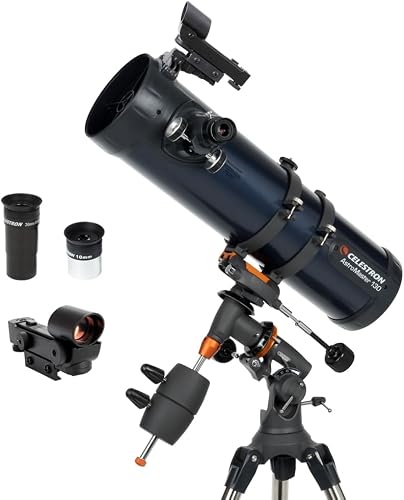
Celestron AstroMaster 130EQ
- 130 mm (5 in.) Newtonian reflector, per the listing
- Equatorial mount with slow-motion controls for RA and declination
- 20 mm (erect image) and 10 mm eyepieces; StarPointer red dot finder
- No tools needed to set up
If you want low maintenance: a refractor
Refractors don't need mirror alignment. The Inspire 100AZ gives you 100 mm, erect-image optics for daytime use too, and a lens cap that doubles as a phone adapter, per the listing.
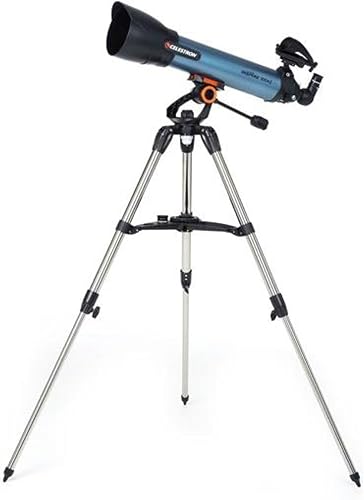
Celestron Inspire 100AZ
- 100 mm refractor (per Celestron) with erect-image optics
- Lens cap doubles as a smartphone adapter, per the listing
- Red LED flashlight stored in the mount head
- Folding accessory tray
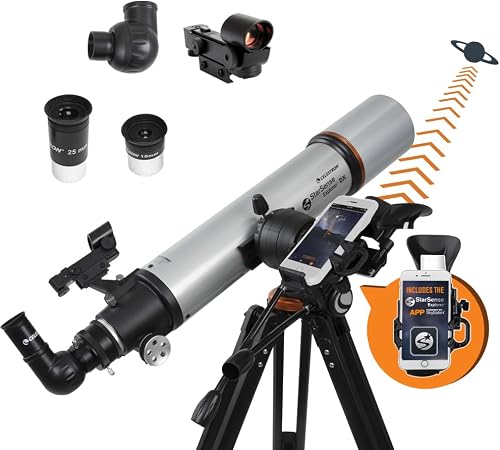
Celestron StarSense Explorer DX 102AZ
- 102 mm (4 in.) refractor, per the listing
- Phone dock + StarSense app
- Manual alt-azimuth mount with dual-axis slow-motion controls
If you want the most light: an 8 inch Dobsonian
An 8 inch (203 mm) mirror collects about 2.4 times the light of a 130 mm one. The trade-off is size: Sky-Watcher's Classic 200 is about 45 pounds assembled, in two pieces. Our Dobsonian guide covers the options.
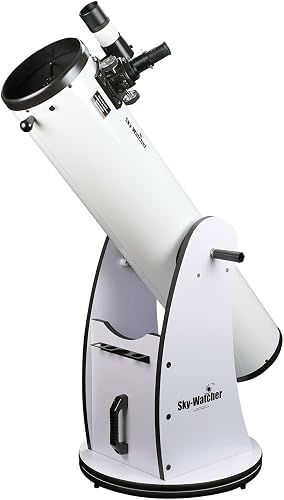
Sky-Watcher Classic 200 Dobsonian (8 in.)
- 8 in. solid-tube Dobsonian, per the listing
- 2 in. Crayford focuser with 1.25 in. adapter
- 25 mm and 10 mm eyepieces; 9x50 finder
- About 45 lb assembled (20 lb tube, 25 lb base)
Or start with binoculars
NASA's Night Sky Network calls binoculars "an excellent first instrument" and suggests nothing much bigger than 10x50 at first. They'll show the Moon's craters, the Pleiades and, from dark skies, the Andromeda Galaxy. See binoculars for astronomy.
What to add later
A Moon filter, a red flashlight and a planisphere make the first nights easier (see astronomy accessories). Then read how to use a telescope and what you can actually see.
FAQ
What matters most?
Aperture, then an easy, steady mount.
Is high magnification good?
Not past about 60x per inch of aperture, per Celestron.
Refractor or reflector?
Either; Dobsonian reflectors give the most aperture for the money, per Sky-Watcher.
Sources
- Celestron: Astronomy glossary
- Celestron: Which eyepieces to use
- Celestron: StarSense Explorer DX 130AZ specs
- Celestron: StarSense Explorer LT 114AZ specs
- Celestron: AstroMaster 130EQ specs
- Celestron: Inspire 100AZ specs
- Sky-Watcher USA: Flextube/Heritage product sheet (PDF)
- NASA: Binoculars, a great first telescope