
Telescope Eyepieces: Which Focal Lengths to Get, and Sets Worth a Look
EyepieceLab is reader-supported. If you buy through our links we may earn a commission at no extra cost to you. As an Amazon Associate we earn from qualifying purchases. Disclosure.
Eyepieces are where most telescopes get better without buying a new telescope. The math is simple once you see it laid out. Formulas below are from Celestron and Tele Vue; product details are from the listings. We haven't tested these.
The math in three lines
- Magnification = telescope focal length ÷ eyepiece focal length (Celestron).
- Highest useful magnification is about 60x per inch (25.4 mm) of aperture; lowest is 3.6x per inch (Celestron).
- True field of view = eyepiece apparent field ÷ magnification (Celestron).
Our magnification guide has a worked table for common scopes.
Picking focal lengths for your scope
| Eyepiece | 650 mm scope (130 mm f/5) | 1200 mm scope (8 in. Dob) | 2032 mm scope (8SE) |
|---|---|---|---|
| 32 mm | 20x | 38x | 64x |
| 25 mm | 26x | 48x | 81x |
| 15 mm | 43x | 80x | 135x |
| 9 mm | 72x | 133x | 226x |
| 6 mm | 108x | 200x | 339x |
Our arithmetic using Celestron's formula. Celestron lists the highest useful magnification as 307x for its 130 mm f/5 scopes and 480x for the 8SE.
Tele Vue's Al Nagler gives a rule of thumb worth remembering: "For the best low-power views, use the highest power that frames the subject. For the best high-power views, use the lowest power that reveals the detail you're looking for."
Kits: the easy way to cover the range
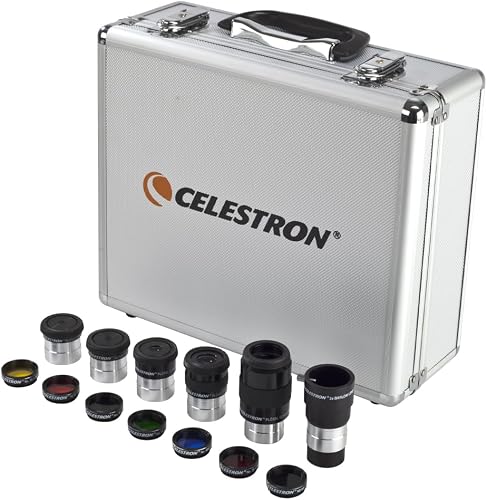
Celestron Eyepiece, Barlow & Filter Kit
Five Plössl eyepieces (32, 17, 13, 8 and 6 mm), a 2x Barlow, a Moon filter and colored planetary filters in a foam-lined case, per the listing. With the Barlow, that's ten magnifications.
Celestron Eyepiece, Barlow & Filter Kit (1.25 in.)
- 5 Plossl eyepieces: 32, 17, 13, 8 and 6 mm, per the listing
- 2x Barlow lens
- Moon filter plus colored planetary filters
- Foam-lined hard case
SVBONY kits
The SV233 7-piece kit has 6 mm and 17 mm Plössls, a 2x Barlow and Moon, 82A and ND4 filters. The Gold Line set gives four 66° wide-angle eyepieces (6, 9, 15 and 20 mm), per the listings.
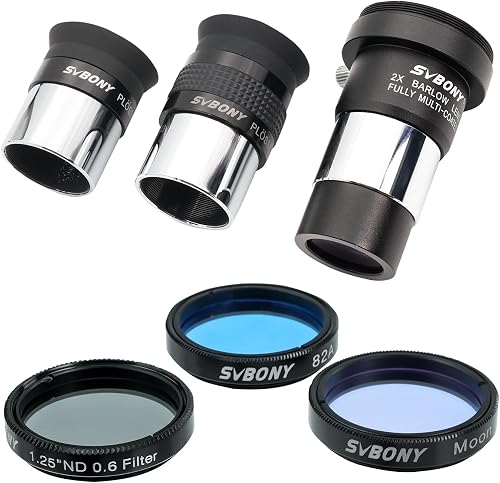
SVBONY SV233 7-Piece Eyepiece & Filter Kit
- 6 mm and 17 mm Plossl eyepieces, 48° field, per the listing
- 2x Barlow with T-thread
- Moon, 82A and ND4 filters; storage bag
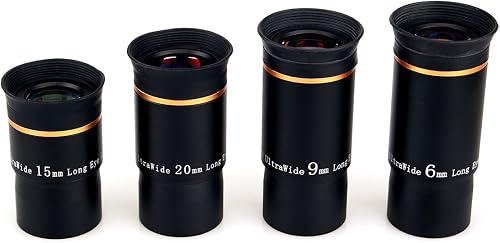
SVBONY Gold Line Eyepiece Set (6/9/15/20mm)
- Four 1.25 in. eyepieces: 6, 9, 15 and 20 mm, per the listing
- 66° apparent field
- Fold-down eyecups; filter threads
Single eyepieces worth a look
Celestron's X-Cel LX line offers a 60° field, six fully multi-coated elements and twist-up eyeguards, per the listing. The Ultima Edge 24 mm gives a 65° flat field and 29 mm of eye relief, which helps if you wear glasses (Celestron's glossary says at least 15 mm is comfortable).
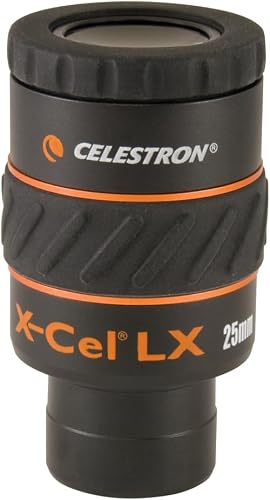
Celestron X-Cel LX 25mm Eyepiece
- 60° field, six-element fully multi-coated, per the listing
- Twist-up rubber eyeguard
- 1.25 in. barrel threaded for filters
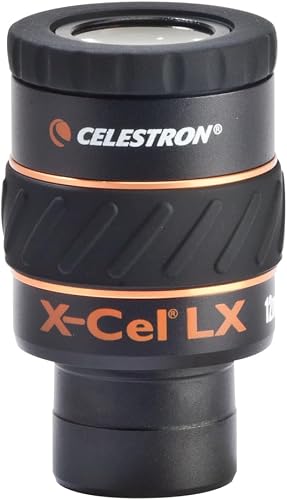
Celestron X-Cel LX 12mm Eyepiece
- 60° field, six-element fully multi-coated, per the listing
- Twist-up rubber eyeguard
- 1.25 in. barrel threaded for filters
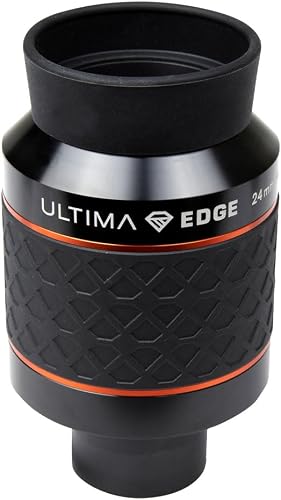
Celestron Ultima Edge 24mm Eyepiece
- 24 mm flat-field, 1.25 in., per the listing
- 65° apparent field; 8 elements, fully multi-coated
- 29 mm eye relief; fold-down eyeguard
Barrel size
Most beginner scopes take 1.25 inch eyepieces. Some Dobsonians, like Sky-Watcher's Classic 200, have a 2 inch focuser with a 1.25 inch adapter, per the listing, so both fit.
Next: Barlow lenses double what you've got, and a Moon filter tames the glare.
FAQ
How do I calculate magnification?
Telescope focal length ÷ eyepiece focal length.
What to buy first?
Fill the gaps: mid-power ~15 mm, high-power ~6-9 mm.
What's apparent field?
How wide the view looks; wider shows more sky.