
Moon Filters: Taming the Glare (and Why They're Not Solar Filters)
EyepieceLab is reader-supported. If you buy through our links we may earn a commission at no extra cost to you. As an Amazon Associate we earn from qualifying purchases. Disclosure.
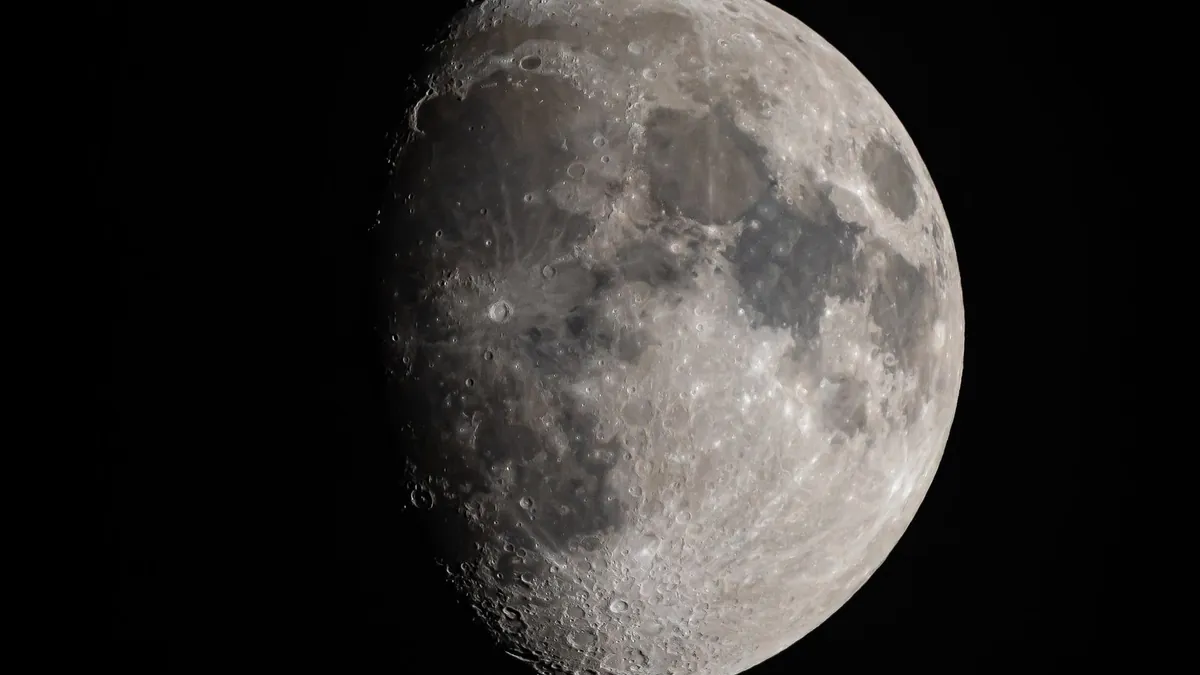
Your first look at a gibbous Moon through a telescope can be almost too bright. A Moon filter is a small fix. Product details come from Celestron's Amazon listings and its knowledge base.
Transmission by filter, and which aperture it suits
Every Moon filter is described by one number, the share of light it lets through. Celestron publishes that number for each of its filters, and its Moon Filter Set page gives the rule for matching them to a telescope: "Use the darkest filter with larger aperture telescopes and lower magnification eyepieces. Use the lighter filters with smaller telescopes and higher magnification eyepieces." Celestron's knowledge base adds that its 25% green Moon filter is made for scopes "under 127mm in aperture." The table puts those figures together.
| Filter | Light transmission (Celestron) | Type | Aperture guidance (Celestron) | Stackable |
|---|---|---|---|---|
| Celestron Moon Filter 94119-A (the fixed filter on this page) | 25% | #58 green glass | Smaller scopes, under 127 mm | No, threaded one side |
| Celestron Neutral Density Moon Filter 94105 (the NexGo DX kit's filter is also listed at 13%) | 13% | Neutral density, true color | Larger apertures and low power | Yes |
| Moon Filter Set: ND96-0.9 | 13% | Neutral density | Larger apertures, lower magnification | Yes |
| Moon Filter Set: ND96-0.6 | 25% | Neutral density | Mid-size scopes | Yes |
| Moon Filter Set: ND96-0.3 | 50% | Neutral density | Smaller scopes, higher magnification | Yes |
| Celestron Variable Polarizing Filter 94107 | 1% to 40%, adjustable | Two rotating polarizers | Any; dial it in by phase and power | Yes |
Why aperture and magnification both matter: the glossary says light gathering rises with the square of the aperture, and the exit pupil, which sets how bright the view looks, shrinks as magnification rises (Tele Vue). An 8 inch scope at 48x therefore shows a far brighter Moon than a 70 mm scope at 90x, and wants the darker filter. A useful way to picture a filter's effect is the aperture it makes your scope behave like for brightness: because light grasp goes as aperture squared, a filter passing T of the light makes a scope of aperture D as bright as an unfiltered scope of D × √T. That arithmetic is ours, from Celestron's aperture-squared rule.
| Scope aperture | With 50% filter, as bright as | With 25% filter | With 13% filter |
|---|---|---|---|
| 70 mm | 49 mm unfiltered | 35 mm | 25 mm |
| 100 mm | 71 mm | 50 mm | 36 mm |
| 130 mm | 92 mm | 65 mm | 47 mm |
| 150 mm | 106 mm | 75 mm | 54 mm |
| 203 mm | 144 mm | 102 mm | 73 mm |
| 254 mm | 180 mm | 127 mm | 92 mm |
So a 13% filter on an 8 inch Dob brings the Moon's brightness down to roughly what a 73 mm refractor shows unfiltered, which is comfortable; the same filter on a 70 mm scope leaves you with the brightness of a 25 mm finder scope, which is why Celestron steers small scopes toward the 25% and 50% options. Resolution is unaffected: the filter changes brightness, not the aperture that sets detail.
Your options
Fixed Moon filter
Celestron's 1.25 inch Moon filter (model 94119-A) reduces glare and increases lunar contrast, and the listing says it's also useful on extra-bright planets and for daytime viewing over sand or snow. Celestron's knowledge base describes it as a #58 green filter with 25% transmission, made for scopes under 127 mm, and threaded on one side only.

Celestron Moon Filter (1.25 in.)
- Cuts glare and boosts lunar contrast
- Threads onto most 1.25 in. eyepieces
- Not a solar filter
Variable Moon filter
Rotate the lower ring to set light transmission anywhere from 1 to 40%. That helps because the Moon's brightness changes a lot between crescent and full. Celestron's knowledge base says it uses two polarized elements rotated against each other, keeps color neutral, and is also useful for splitting double stars with one bright member and for darkening the daytime sky when hunting Venus or Jupiter.
Celestron Variable Moon Filter
- Adjustable 1-40% light transmission
- Rotate the lower ring to dim
- Threads onto Celestron 1.25 in. eyepieces
- Not a solar filter
Moon filter set
Three neutral density filters (ND96-0.9 at 13%, ND96-0.6 at 25% and ND96-0.3 at 50%) plus a Moon & Sky Glow filter, in stackable aluminum cells with a Moon map. Celestron's product page says the darkest is for larger apertures and lower magnifications, the lighter ones for smaller scopes and higher power, and the cells thread top and bottom so two can stack for even less light.
Celestron Moon Filter Set
- Three ND filters: 13%, 25% and 50% transmission
- Moon & Sky Glow filter
- Stackable aluminum cells; case with Moon map
- Not a solar filter
Other ways to get one
Celestron's 1.25 inch accessory kit and the SVBONY SV233 kit both include a Moon filter alongside eyepieces, and Celestron's NexGo DX phone-adapter kit bundles the 13% neutral density filter, per its listing.
Celestron Eyepiece, Barlow & Filter Kit (1.25 in.)
- 5 Plossl eyepieces: 32, 17, 13, 8 and 6 mm
- 2x Barlow lens
- Moon filter plus colored planetary filters
- Foam-lined hard case
Celestron NexGo DX Kit (Phone Adapter + Moon Filter)
- Phone adapter for eyepieces 25.4-44.45 mm across
- Bluetooth shutter remote
- 13% transmission Moon filter
Tips
- The Moon is often most dramatic near first or last quarter, when shadows along the terminator show crater depth. A quarter Moon also needs less filtering than a full one, which is the case for the variable filter or a set.
- Filters thread into the bottom of the eyepiece, per Celestron, so swap the filter before you swap eyepieces, or buy one for each eyepiece you use on the Moon.
More targets in what you can see with a telescope.
FAQ
What does a Moon filter do?
It dims the Moon's glare so you can see more surface detail. Celestron's listing says its Moon filter reduces glare and increases contrast, and is also useful on very bright planets.
Can I use a Moon filter to look at the Sun?
No. The AAS says filters that thread into an eyepiece at the back of the telescope are dangerous for solar viewing. A solar filter must be attached securely to the front of the telescope.
Fixed or variable Moon filter?
A variable filter lets you adjust transmission: 1 to 40% on Celestron's, according to its listing. A set of fixed ND filters (13%, 25% and 50% in Celestron's set) does a similar job by swapping or stacking.
Which Moon filter for an 8 inch telescope?
Celestron's Moon Filter Set page says to use the darkest filter (13%) with larger apertures and lower magnifications, and the lighter ones with smaller scopes and higher power. Celestron's knowledge base describes its 25% green Moon filter as made for scopes under 127 mm.