
Solar Filters for Telescopes and Binoculars: The Safety Rules First
EyepieceLab is reader-supported. If you buy through our links we may earn a commission at no extra cost to you. As an Amazon Associate we earn from qualifying purchases. Disclosure.
Solar observing is a great hobby on its own: sunspots, eclipses and transits. It's also the one area of astronomy where a mistake can permanently damage your eyes in an instant. So this page leads with the rules, quoted from NASA and the AAS, and only then gets to products.
The rules
- Front of the optics only. NASA: viewing the Sun through "binoculars, or a telescope without a special-purpose solar filter secured over the front of the optics will instantly cause severe eye injury." The AAS: "In every case, the solar filter must be attached to the front of your telescope, binoculars, or camera lens."
- No eyepiece filters. The AAS: filters "designed to thread into an eyepiece at the back end of the telescope ... are dangerous ... If you have such a filter ... discard it." Moon filters are not solar filters either; never use one on the Sun.
- No eclipse glasses on optics. NASA: don't look through a telescope, binoculars or camera while wearing eclipse glasses; "the concentrated solar rays will burn through the filter."
- Secure it. The AAS says to attach it so it "won't pop off if your instrument is bumped or the wind suddenly gusts."
- Cover the finder. The AAS says a finderscope should be "capped, removed, or safely filtered just like the main telescope."
- Get experienced help. NASA says to "seek expert advice from an astronomer before using a solar filter with a camera, telescope, binoculars, or any other optical device." The AAS says solar filters for optics "should be used only by experienced observers."
- Inspect before use. NASA says to discard any viewer that's torn, scratched or damaged, and to supervise children.
Where to buy
The AAS keeps a list of solar filter manufacturers and advises buying "directly from known manufacturers or any authorized dealers those manufacturers publicly identify." Celestron (EclipSmart) and Thousand Oaks Optical are both on its list of optics filter suppliers. The AAS also warns, about eclipse viewers, that buying "from online marketplaces ... is not worth the risk to your eyes." So before you buy anywhere, including through the links below, check that the item is sold by the maker or an authorized dealer the maker names, or buy direct.
A note on the "ISO" claims you'll see: the AAS says the ISO 12312-2 standard covers eclipse glasses and handheld viewers, not filters for the front of telescopes, and that no product should claim to be "ISO certified" or "ISO compliant." Front-of-scope filters can still be safe if they meet that standard's requirements, are mounted securely, and are used according to the supplier's instructions, per the AAS.
Filters sized for specific scopes
Celestron makes EclipSmart front filters for its 6 and 8 inch Schmidt-Cassegrains and for its 127 and 130 mm reflectors (the listing names the PowerSeeker 127EQ and NexStar 130SLT, among others). Each straps over the front of the tube; the 6 and 8 inch listings say the film is made in the USA by American Paper Optics.
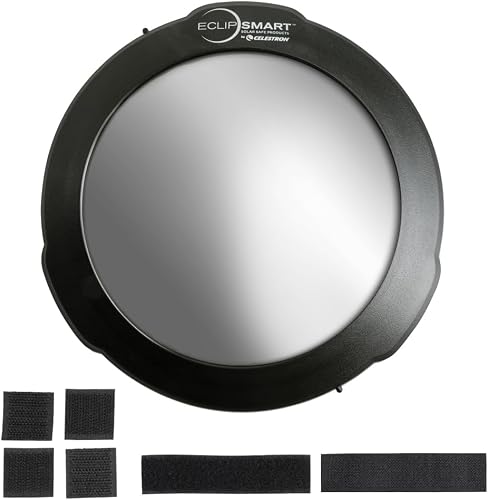
Celestron EclipSmart 8 in. Solar Filter
- Front-mounted solar filter for Celestron 8 in. SCT and EdgeHD, per the listing
- Two hook-and-loop straps
- Film made in the USA by American Paper Optics
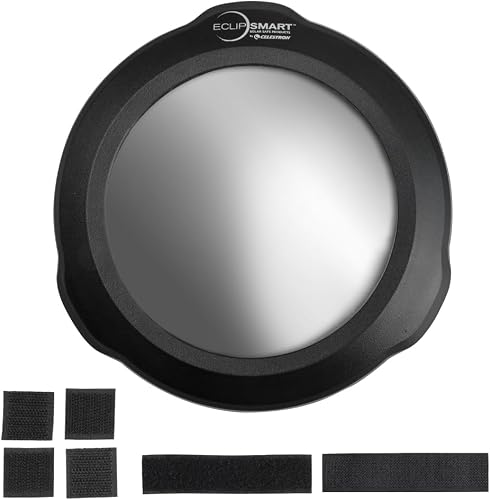
Celestron EclipSmart 6 in. Solar Filter
- Front-mounted solar filter for Celestron 6 in. SCTs, per the listing
- Two hook-and-loop straps
- Film made in the USA by American Paper Optics
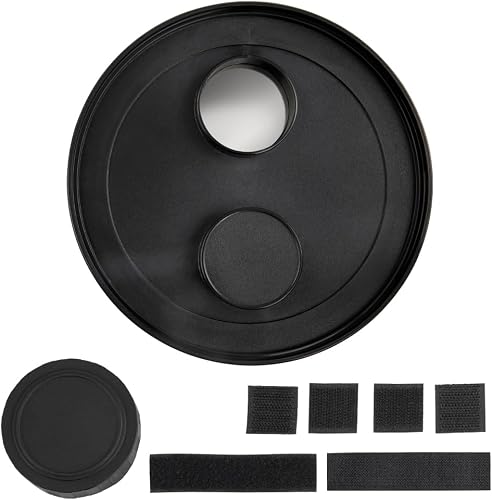
Celestron EclipSmart Solar Filter for 127/130mm Reflectors
- Listed for the PowerSeeker 127EQ, NexStar 130SLT and other 127/130 mm Celestron scopes
- Two hook-and-loop straps; safety cap
Universal fit
The EclipSmart Universal filter fits optics with a 75 to 100 mm outside diameter using adjustable side panels and an elastic band, per the listing. Measure the outside of your tube's front end first.
Celestron EclipSmart Universal Solar Filter
- Fits objectives with a 75-100 mm outside diameter, per the listing
- Adjustable side panels plus elastic band
- Folds flat for storage
Make your own: Thousand Oaks film
Thousand Oaks Optical sells black and silver-black polymer solar film sheets for building a front filter. This is for experienced observers: the AAS says optics filters "should be used only by experienced observers," and NASA advises getting expert advice first. The listing itself warns to make sure the filter is well attached, using tape, so it can't fall off. If you go this route, build a snug cell that covers the full front opening.
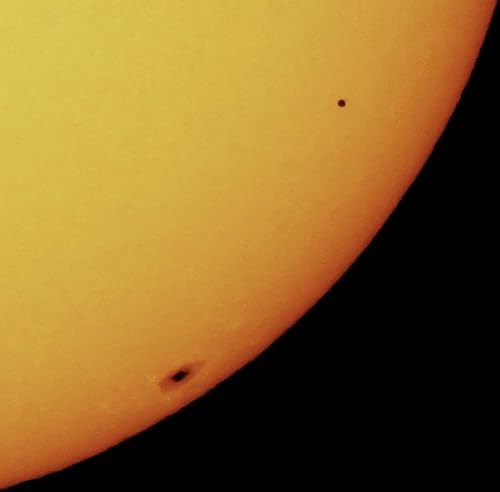
Thousand Oaks Optical 8x8 in. Solar Filter Sheet
- Black polymer solar film sheet, per the listing
- Make your own front filter for a telescope, binoculars or camera
- Listing warns to tape it securely to the optics
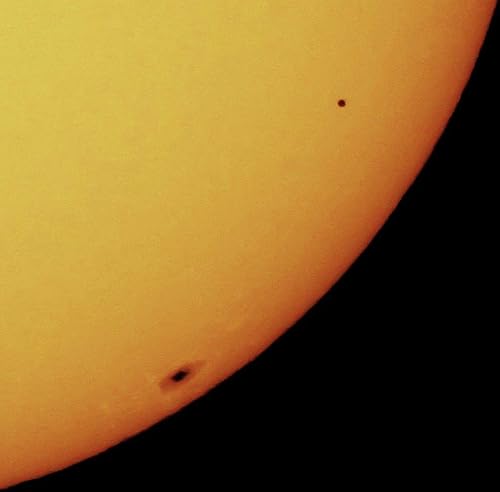
Thousand Oaks Optical 6x6 in. Solar Filter Sheet
- Silver-black polymer solar film sheet, per the listing
- For DIY front filters
- Listing warns to tape it securely to the optics
Solar binoculars
Celestron's EclipSmart 12x50 binoculars have permanently attached solar filters, per the listing, so they can't be knocked off. They're for the Sun only.
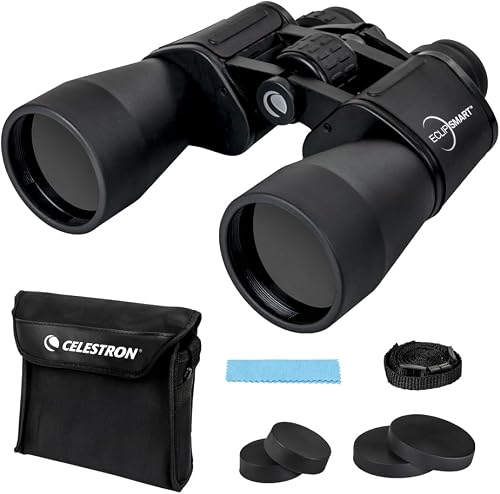
Celestron EclipSmart 12x50 Solar Binoculars
- 12x50 binoculars with built-in solar filters, per the listing
- Filters permanently attached
- For viewing the Sun only
FAQ
Can I look at the Sun through a telescope?
Only with a proper solar filter on the front.
Eyepiece sun filters?
Dangerous; discard them.
Eclipse glasses with a telescope?
No.
The finderscope?
Cap, remove or filter it.