Learn the sky: a reading order
These five guides are written to be read in sequence, and together they cover what a telescope can and cannot do before you spend anything. Every claim in them is cited to NASA, the American Astronomical Society, Celestron, Sky-Watcher or Tele Vue, and where we do arithmetic from a published formula we say so.
- Set expectations. What can you actually see uses NASA's own descriptions: Jupiter's four large moons and cloud bands in a modest scope, Saturn's rings, the Moon's craters, and whether a backyard view ever looks like a Hubble image (NASA's answer: no). Read this first; it prevents the most common disappointment.
- Learn the controls. How to use a telescope covers aligning the finder in daylight, starting at low power, letting the tube cool (Celestron's glossary says using it before cooldown degrades the image), and the 20 to 40 minutes the National Park Service says your eyes need to adapt.
- Do the math once. Telescope magnification explained gives the formula, Celestron's 60x-per-inch ceiling, Tele Vue's 20 to 30x-per-inch working range, and a table of magnification and exit pupil for a standard eyepiece set across eight popular scopes.
- Understand the designs. Refractor vs reflector vs Schmidt-Cassegrain explains how each works from Celestron's definitions, then puts the numbers on aperture: light gathering, Dawes resolution and limiting magnitude for every size from 60 to 305 mm.
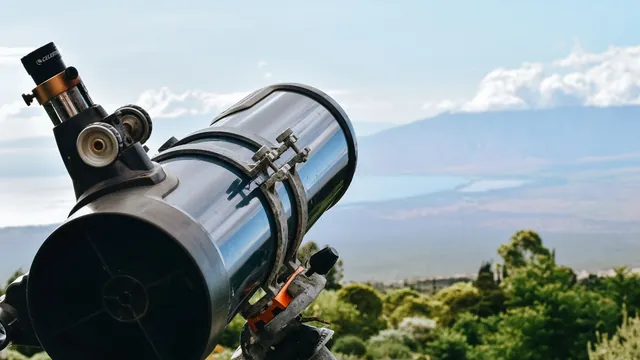
- Keep a reflector sharp. How to collimate a telescope walks through Celestron's daylight method for a Newtonian's two mirrors and lists which scopes on this site need it, by mirror type and focal ratio.
Two safety rules run through all five. Never look at the Sun through any optics without a solar filter secured over the front; NASA says doing so "will instantly cause severe eye injury." And never buy on the magnification printed on a box; Celestron's own useful limit for a 70 mm scope is about 165x, whatever the packaging says. When you are ready to shop, the telescope guides and eyepiece and accessory guides use the same sources.