
Telescope Magnification Explained: The Formula and the Real Limits
EyepieceLab is reader-supported. If you buy through our links we may earn a commission at no extra cost to you. As an Amazon Associate we earn from qualifying purchases. Disclosure.
Magnification gets a lot of space on telescope boxes. Here's the math, from Celestron's knowledge base and glossary and Tele Vue's Al Nagler, with worked examples.
The formula
Magnification = telescope focal length ÷ eyepiece focal length (Celestron glossary).
Example: a 1200 mm Dobsonian with a 25 mm eyepiece gives 48x; with a 10 mm, 120x.
The useful limits
- Highest useful: Celestron: past this point "the image will be magnified but will not carry or enhance any more details. This is generally defined as 60x per inch (25.4mm) of aperture." That figure assumes "a night of good stable atmosphere," a cooled scope and good collimation.
- Lowest useful: "3.6x per inch (25.4mm) of aperture," per Celestron. Below that, the exit pupil gets wider than your dark-adapted eye, which Tele Vue puts at about 7 mm.
- Practical: Tele Vue's Nagler: planetary observers use "20x to 30x per inch of aperture"; double-star observers go "up to 50x per inch."
Worked examples from Celestron's own specs
| Telescope | Aperture | Focal length | Highest useful (Celestron) |
|---|---|---|---|
| Travel Scope 70 | 70 mm | 400 mm | 168x |
| Inspire 100AZ | 100 mm | 660 mm | 241x |
| AstroMaster 130EQ | 130 mm | 650 mm | 307x |
| NexStar 6SE | 150 mm | 1500 mm | 354x |
| NexStar 8SE | 203.2 mm | 2032 mm | 480x |
The "empty magnification" trap
Celestron's PowerSeeker 127EQ comes with a 4 mm eyepiece and a 3x Barlow. 1000 mm ÷ 4 mm = 250x; with the Barlow, 750x. Celestron lists that scope's highest useful magnification as 300x. Tele Vue's Nagler called this kind of setup out decades ago: "The 600-power, 2.4-inch 'department store' telescope is a prime example." More in AstroMaster 130EQ vs PowerSeeker 127EQ.
Exit pupil and focal ratio
- Focal ratio = focal length ÷ aperture (Celestron). A 1200 mm, 203 mm scope is about f/5.9.
- Exit pupil = aperture ÷ magnification (Celestron), or eyepiece focal length ÷ focal ratio (Tele Vue). A 35 mm eyepiece on an f/5 scope gives a 7 mm exit pupil, Tele Vue's example.
- Tele Vue also says "F/number is of little importance visually": fast and slow scopes of the same aperture show the same image brightness and resolution. Fast scopes just give wider fields.
Field of view
True field = eyepiece apparent field ÷ magnification (Celestron glossary). A 50° eyepiece at 50x shows about 1° of sky. Tele Vue's rule of thumb: "For the best low-power views, use the highest power that frames the subject."
Putting it to work
See telescope eyepieces for a focal-length table across common scopes, and Barlow lenses for doubling what you have.
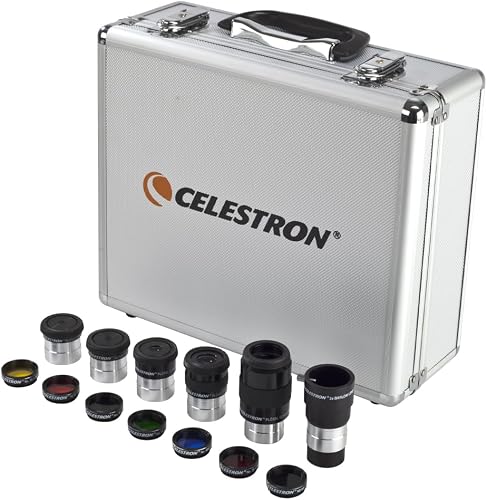
Celestron Eyepiece, Barlow & Filter Kit (1.25 in.)
- 5 Plossl eyepieces: 32, 17, 13, 8 and 6 mm, per the listing
- 2x Barlow lens
- Moon filter plus colored planetary filters
- Foam-lined hard case
FAQ
How do you calculate magnification?
Telescope focal length ÷ eyepiece focal length.
Maximum useful magnification?
About 60x per inch of aperture, per Celestron.
What is exit pupil?
The width of the light beam leaving the eyepiece.