
Refractor Telescopes: Simple, Low-Maintenance Scopes Compared
EyepieceLab is reader-supported. If you buy through our links we may earn a commission at no extra cost to you. As an Amazon Associate we earn from qualifying purchases. Disclosure.
A refractor is the "classic" telescope shape: a lens at the front, an eyepiece at the back. Celestron's glossary describes light passing "in a straight line from the front objective lens directly to the eyepiece." Here's how four Celestron refractors compare, from its spec pages. We haven't tested them.
Compared
| Model | Aperture / focal length | Included eyepieces | Highest useful mag. | Kit weight |
|---|---|---|---|---|
| Travel Scope 70 | 70 mm / 400 mm, f/5.7 | 20 mm (20x), 10 mm (40x) | 168x | 3.3 lb |
| AstroMaster 70AZ | 70 mm (listing) | 20 mm, 10 mm (listing) | See listing | See listing |
| Inspire 100AZ | 100 mm / 660 mm, f/6.5 | 20 mm (33x), 10 mm (66x) | 241x | 12.4 lb |
| StarSense DX 102AZ | 102 mm (listing) | See listing | See listing | See listing |
From Celestron's spec pages unless marked "listing."
Travel Scope 70
About as portable as a real telescope gets: 1.5 pound tube, 3.3 pound kit, and it all goes in the included backpack, per Celestron. Good for the Moon, bright planets and daytime scenery.
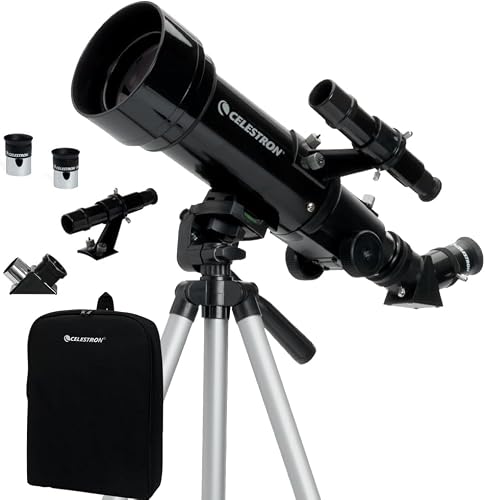
Celestron Travel Scope 70
- 70 mm refractor with fully coated lenses, per the listing
- 20 mm and 10 mm eyepieces; finderscope and star diagonal
- Packs into the included backpack
AstroMaster 70AZ
A 70 mm achromat on a full-height alt-az mount with a panhandle, erect-image diagonal and StarPointer finder, per the listing.
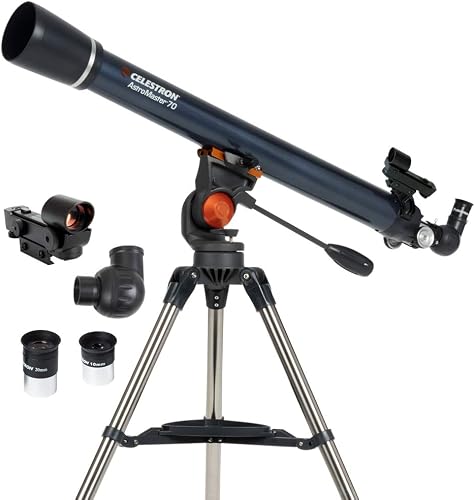
Celestron AstroMaster 70AZ
- 70 mm (2.8 in.) achromatic refractor, per the listing
- Manual alt-azimuth mount with panhandle
- 20 mm and 10 mm eyepieces, erect image diagonal, StarPointer finder
Inspire 100AZ
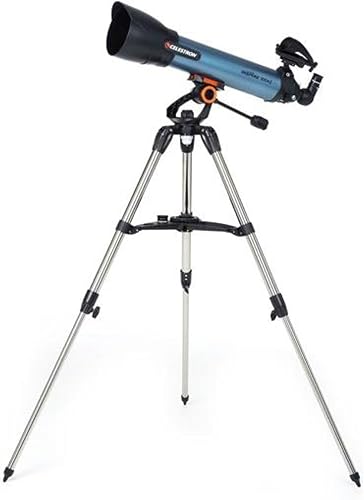
More aperture on a sturdier mount, plus a few clever touches: a red LED flashlight stored in the mount head and a lens cap that works as a phone adapter, per the listing.
Celestron Inspire 100AZ
- 100 mm refractor (per Celestron) with erect-image optics
- Lens cap doubles as a smartphone adapter, per the listing
- Red LED flashlight stored in the mount head
- Folding accessory tray
StarSense Explorer DX 102AZ
A 102 mm refractor with Celestron's phone dock and StarSense app to guide you to targets, per the listing.
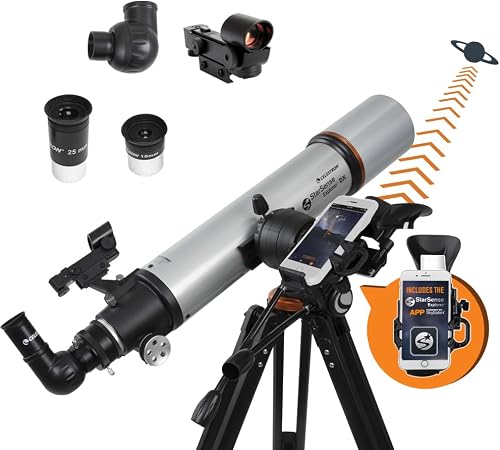
Celestron StarSense Explorer DX 102AZ
- 102 mm (4 in.) refractor, per the listing
- Phone dock + StarSense app
- Manual alt-azimuth mount with dual-axis slow-motion controls
Refractor or reflector?
Our refractor vs reflector guide lays out the trade-offs. Short version: refractors have no mirrors to align; Dobsonian reflectors give more aperture for the money, per Sky-Watcher.
FAQ
How does a refractor work?
A front lens focuses light straight back to the eyepiece.
Do they need collimation?
Celestron's collimation guides target reflectors.
Is 70 mm enough?
For the Moon and bright planets, yes.