
Telescopes for Planets: Aperture, Focal Length and Steady Air
EyepieceLab is reader-supported. If you buy through our links we may earn a commission at no extra cost to you. As an Amazon Associate we earn from qualifying purchases. Disclosure.
Steady air matters as much as the telescope. Here's what actually helps, per Celestron, Tele Vue and NASA. Product details are from the makers and listings; we haven't tested them.
What helps
- Aperture for resolution. Celestron's glossary says aperture sets a telescope's maximum resolution. More aperture means finer detail is possible.
- The right magnification. Nagler: "Experienced planetary observers use 20x to 30x per inch of aperture to see the most planetary detail." Celestron sets the hard ceiling at about 60x per inch.
- Steady air (seeing). Celestron warns that too much power on a poor night "will only magnify the turbulence in the atmosphere."
- A cooled-down scope. Celestron's glossary notes that using a telescope before it reaches outdoor temperature "can result in degraded image quality." Set it out early.
- Timing. NASA says outer planets are best near opposition, when they're up all night.
What you can expect
NASA says small telescopes show all four of Jupiter's Galilean moons (when all are visible) and its cloud bands, and, "if powerful enough," the Great Red Spot. NASA's skywatching FAQ says binoculars or a small telescope can show the rings of Saturn.
Telescopes that suit planets
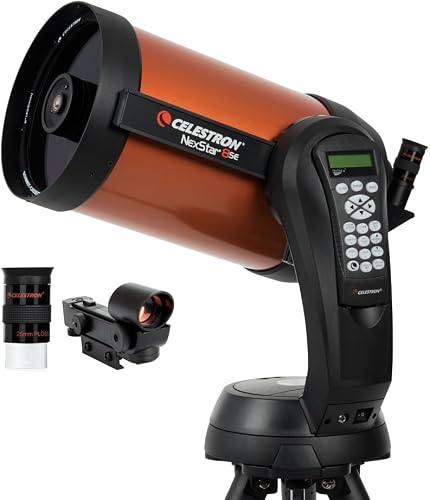
Celestron NexStar 8SE
An 8 inch Schmidt-Cassegrain with a long 2032 mm focal length, per Celestron, so you reach planetary magnifications without very short eyepieces. GoTo tracking keeps the planet centered at high power, which matters more than you'd think.
Celestron NexStar 8SE
- 8 in. Schmidt-Cassegrain optics, per the listing
- Computerized GoTo mount with NexStar+ hand control; 40,000+ object database
- SkyAlign: center any three bright objects to align
- 2-year US warranty
8 inch Dobsonian
The same 8 inch aperture without GoTo; you nudge it by hand. Sky-Watcher's Classic 200 is 1200 mm, f/5.9, per its product sheet.
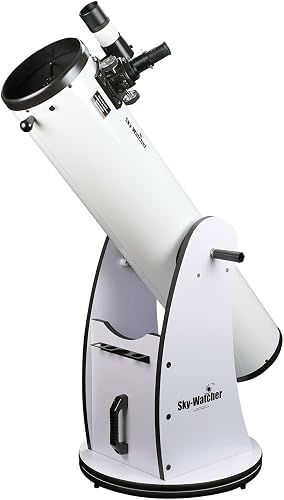
Sky-Watcher Classic 200 Dobsonian (8 in.)
- 8 in. solid-tube Dobsonian, per the listing
- 2 in. Crayford focuser with 1.25 in. adapter
- 25 mm and 10 mm eyepieces; 9x50 finder
- About 45 lb assembled (20 lb tube, 25 lb base)
Smaller, longer refractor or reflector
Celestron's StarSense LT 114AZ has a 1000 mm focal length, per Celestron, which gives 100x with its included 10 mm eyepiece.
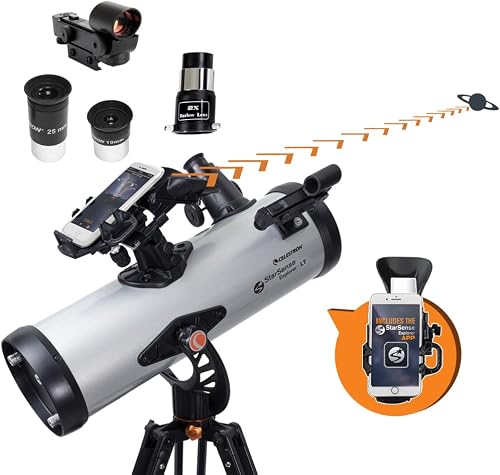
Celestron StarSense Explorer LT 114AZ
- 114 mm (4.5 in.) Newtonian reflector, per the listing
- Phone dock + StarSense app sky recognition
- Manual alt-azimuth mount with altitude slow-motion rod
- 2-year US warranty
Eyepieces for planets
Magnification is telescope focal length divided by eyepiece focal length (Celestron). On a 1200 mm Dob, a 9 mm eyepiece gives about 133x; on the 8SE, a 12 mm gives about 169x.
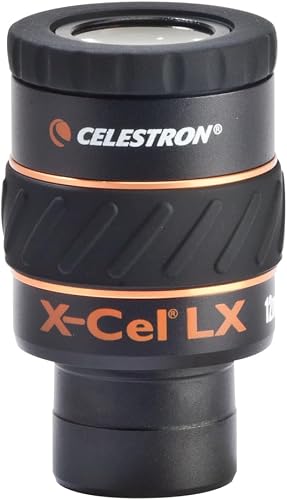
Celestron X-Cel LX 12mm Eyepiece
- 60° field, six-element fully multi-coated, per the listing
- Twist-up rubber eyeguard
- 1.25 in. barrel threaded for filters
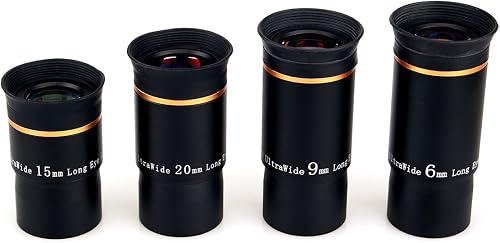
SVBONY Gold Line Eyepiece Set (6/9/15/20mm)
- Four 1.25 in. eyepieces: 6, 9, 15 and 20 mm, per the listing
- 66° apparent field
- Fold-down eyecups; filter threads
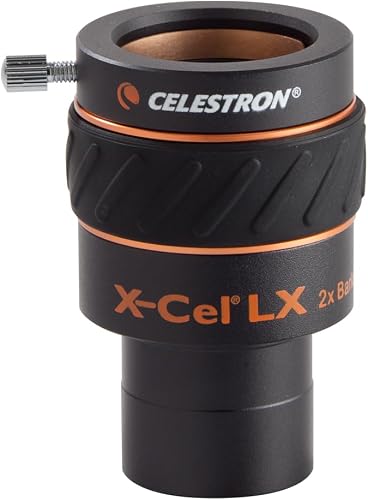
Celestron X-Cel LX 2x Barlow (1.25 in.)
- Doubles the magnification of any 1.25 in. eyepiece, per the listing
- 3-element apochromatic, fully multi-coated
- Threaded for 1.25 in. filters
Colored filters can boost contrast on some planetary features, per Celestron's glossary; the Celestron accessory kit includes a set. More in eyepieces and magnification explained.
FAQ
What magnification for planets?
About 20 to 30x per inch of aperture, per Tele Vue.
Why blurry at high power?
Usually atmospheric turbulence.
Best time for Saturn or Jupiter?
Around opposition.