
How to Collimate a Newtonian Telescope, Step by Step
EyepieceLab is reader-supported. If you buy through our links we may earn a commission at no extra cost to you. As an Amazon Associate we earn from qualifying purchases. Disclosure.
If your reflector's stars won't focus to clean points, the mirrors may be slightly out of line. This walkthrough follows Celestron's knowledge base article on collimating a Newtonian in daylight. Product details are from the listings.
Does your telescope need it?
Celestron: "The optical performance of most Newtonian reflecting telescopes can be optimized by re-collimating (aligning) the telescope's optics, as needed." That includes Dobsonians. Celestron says the Maksutov-Cassegrain design "never needs to be collimated." Refractors generally don't need user collimation.
What you're adjusting
- Primary mirror: the big one at the bottom of the tube, adjusted by "three screws, placed 120 degrees apart" (Celestron).
- Secondary mirror: the small elliptical mirror under the focuser, which "also has three adjustment screws."
- Locking screws: "Always loosen the locking screws first before turning any of the collimation screws," and retighten them when done.
Step by step (Celestron's method)
- Get a collimating tool (Celestron mentions a collimating cap; a Cheshire eyepiece or laser also works) and rack the focuser all the way in.
- Center the primary in the secondary. Look through the tool. If the primary mirror isn't centered in the secondary, "adjust the secondary mirror screws by alternately tightening and loosening them until the periphery of the primary mirror is centered in your view." Celestron says not to touch the secondary's center screw.
- Adjust the primary. "Adjust the primary mirror screws to re-center the reflection of the small secondary mirror, so it's silhouetted against the view of the primary."
- Check and repeat. "As you look into the focuser, silhouettes of the mirrors should look concentric. Repeat steps one and two until you have achieved this."
- Lock it. Tighten the locking screws.
Tools
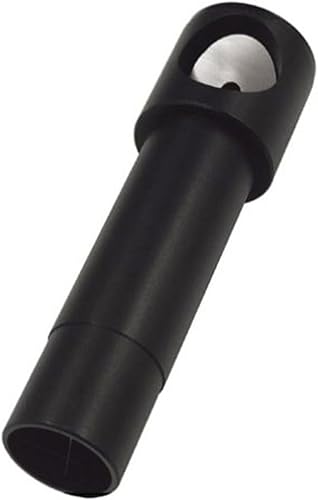
Celestron Cheshire Collimation Eyepiece
- 1.25 in. Cheshire collimating eyepiece, per the listing
- For collimating Newtonians
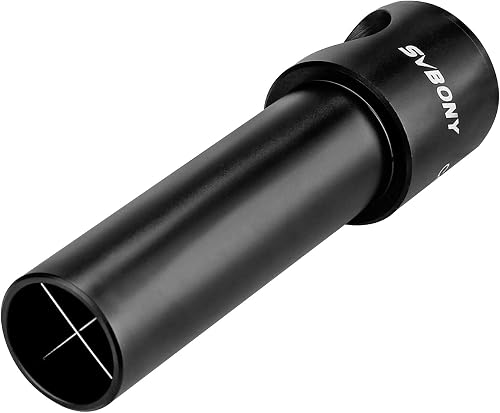
SVBONY SV197 Cheshire Collimating Eyepiece
- 1.25 in. Cheshire with crosshairs and sighting hole, per the listing
- No batteries; daytime use
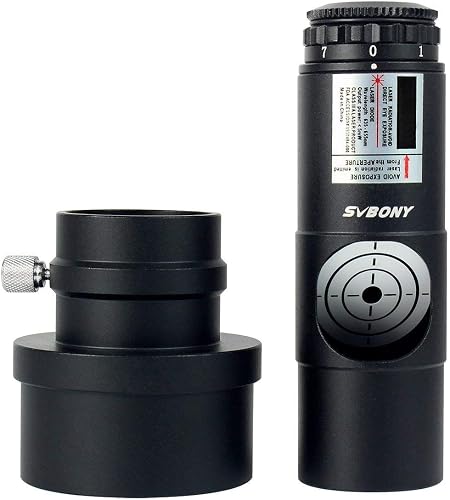
SVBONY Laser Collimator
- For 1.25 in. and 2 in. Newtonian focusers, per the listing
- 7 brightness levels
- Metal body; 2 in. adapter included
Why it matters
Celestron's published highest useful magnifications assume "well collimated optics (for Newtonians and Cassegrains)." A badly aligned scope won't reach them. See magnification explained.
FAQ
What is collimation?
Aligning a telescope's mirrors or lenses.
Which telescopes need it?
Mainly Newtonians and Dobsonians.
Laser or Cheshire?
Either works.