
Binoculars for Astronomy: What the Numbers Mean and Which Size
EyepieceLab is reader-supported. If you buy through our links we may earn a commission at no extra cost to you. As an Amazon Associate we earn from qualifying purchases. Disclosure.
NASA's Night Sky Network calls binoculars "generally easy to use and more versatile than most telescopes." Guidance below is from NASA; product details are from the listings. We haven't tested them.
What the numbers mean
NASA explains it simply: "The first number is the magnification, while the second number is the size in millimeters (mm) of the lenses." So 7x35 magnifies seven times through 35 mm lenses. Divide the second number by the first and you get the exit pupil: 10x50 and 7x35 both give 5 mm. (That formula comes from Tele Vue; the arithmetic is ours.)
Why not go huge?
NASA: "try not to get anything much more powerful than a 10x50 pair at first." Bigger pairs are heavier, have narrower fields, and "jiggle" unless you mount them on a tripod or pay for image stabilization.
What you'll see
Per NASA, a good 7x35 to 10x50 pair shows the Moon (craters down to about 6 miles across), the Pleiades, and from dark skies the Andromeda Galaxy and the Orion Nebula. You may spot Jupiter's moons, but probably not Saturn's rings.
Handheld: 7x50 and 10x50
The Cometron 7x50 has a wide 6.6° field and a tripod socket (adapter not included), per the listing. The UpClose G2 10x50 is a water-resistant porro prism pair that comes with a case and covers.
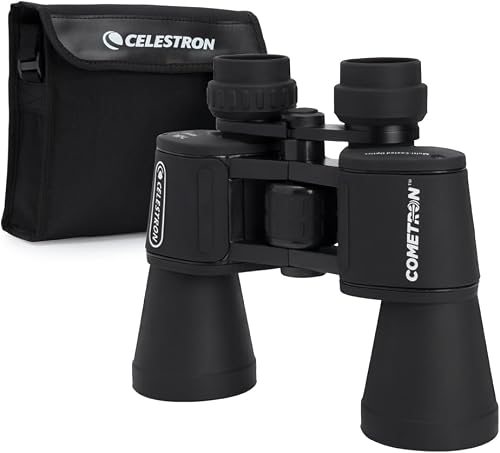
Celestron Cometron 7x50 Binoculars
- 7x magnification, 50 mm objectives, per the listing
- 6.6° field of view
- Tripod-adaptable (adapter not included)
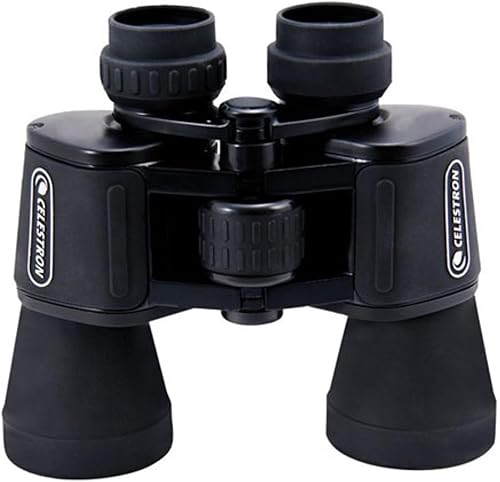
Celestron UpClose G2 10x50 Binoculars
- 10x50 porro prism, per the listing
- Multi-coated BK-7 prisms
- Water-resistant; case and covers included
Giant binoculars (tripod needed)
The SkyMaster 15x70 and 25x100 have big objectives, BaK-4 prisms and a built-in 1/4-20 tripod adapter; For the 25x100, Celestron's listing says "we recommend mounting these binoculars" on a photo tripod; the 15x70 listing says most users do. (The 15x70 listing body also mentions "20x power," which conflicts with its 15x70 title.)
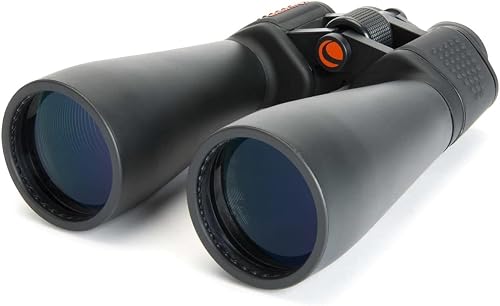
Celestron SkyMaster 15x70 Binoculars
- 15x magnification, 70 mm objectives (title)
- Built-in 1/4-20 tripod adapter
- BaK-4 prisms; water-resistant
Celestron SkyMaster 25x100 Binoculars
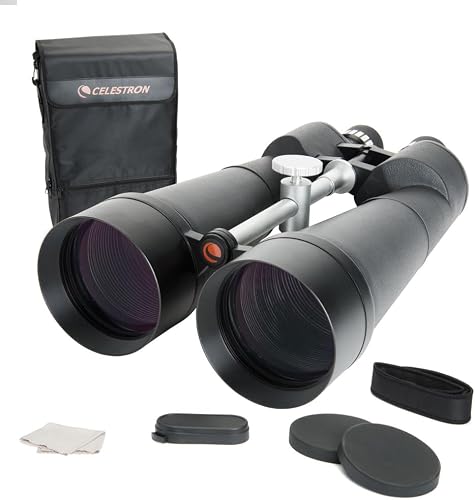
- 25x magnification, 100 mm objectives, per the listing
- Built-in 1/4-20 tripod adapter; tripod not included
- BaK-4 prisms; water-resistant
- Limited lifetime US warranty
For handheld pairs with a tripod socket, an adapter like Celestron's makes long sessions steadier.
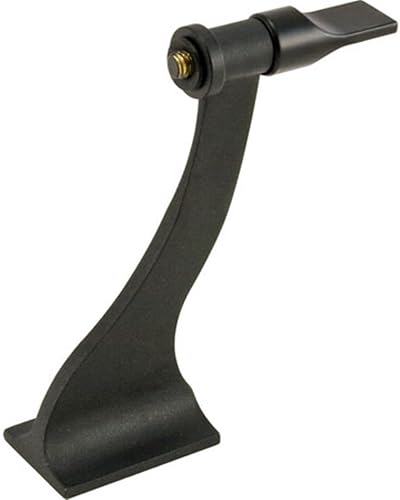
Celestron Binocular Tripod Adapter
- Mounts porro or roof binoculars to a tripod, per the listing
- Standard 1/4-20 thread
Ready for more? See telescopes for beginners and what you can see.
FAQ
What does 10x50 mean?
10x magnification, 50 mm lenses.
Best size to start?
7x35 to 10x50, per NASA.
What can you see?
Moon craters, the Pleiades, Andromeda from dark skies.