
Smart Telescopes: Seestar S30, DWARF 3, DWARF mini and Unistellar Odyssey
EyepieceLab is reader-supported. If you buy through our links we may earn a commission at no extra cost to you. As an Amazon Associate we earn from qualifying purchases. Disclosure.
If the idea of polar alignment and star-hopping makes your eyes glaze over, smart telescopes are the shortcut. Here's how four models compare, from the makers' spec pages and the listings. We haven't tested them.
Side by side
| Seestar S30 | DWARF 3 | DWARF mini | Unistellar Odyssey | |
|---|---|---|---|---|
| Main optics | 30 mm, f/5, 150 mm (ZWO) | Telephoto, 737 mm equivalent (DwarfLab) | See listing | 85 mm, f/3.9, 320 mm (Unistellar) |
| Second camera | Wide-angle (23.2° field) | Wide-angle | See listing | No |
| Sensor | Sony IMX662 | Sony IMX678 | Sony IMX662 (listing) | See maker |
| Weight | 1.65 kg body | About 1.35 kg | 840 g (listing) | 4 kg + 2.5 kg tripod |
| Battery | See maker | Up to 5.5 h (DwarfLab) | See listing | 5 h |
| Storage | 64 GB (about 50 GB usable) | See maker | See listing | 64 GB |
| Solar filter included | Magnetic solar filter (ZWO) | Magnetic ND solar filter (DwarfLab) | Not stated in listing | See maker |
ZWO Seestar S30 and S30 Pro
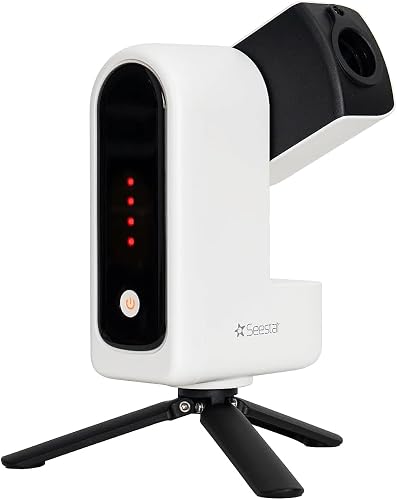
ZWO's FAQ lists the S30 at 30 mm aperture, f/5 and 150 mm focal length, with built-in UV/IR, dark and dual-band light-pollution filters plus a magnetic solar filter. The listing describes Stargazing, Scenery and Solar System modes, and EQ, Plan and Mosaic modes. The S30 Pro lists apochromatic optics with built-in light-pollution filters and dual-camera 4K imaging, per its listing.
ZWO Seestar S30 Smart Telescope
- 3.6 lb (1.65 kg), per the listing
- Telephoto lens plus a wide-angle lens
- Stargazing, Scenery and Solar System modes
- Light pollution filter; EQ, Plan and Mosaic modes
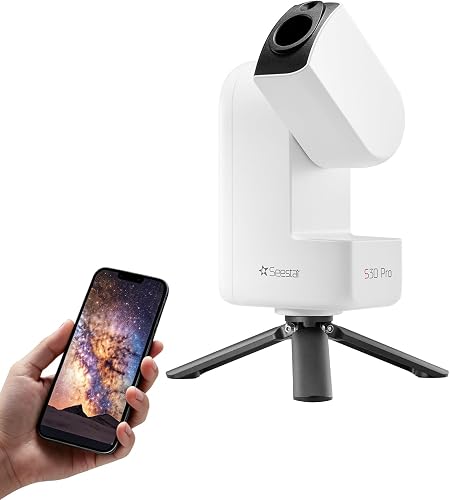
ZWO Seestar S30 Pro Smart Telescope
- Apochromatic optics with built-in light pollution filters, per the listing
- Dual-camera 4K imaging
- Automatic GoTo and tracking
- 3.64 lb
ZWO is refreshingly honest about its larger S50: it "may not meet the requirements for 'serious astrophotography.'" Expect the same of the smaller S30.
DWARF 3 and DWARF mini
DwarfLab lists the DWARF 3 at about 1.35 kg with a Sony IMX678 sensor, a telephoto lens at 737 mm equivalent and a 45 mm-equivalent wide-angle lens, exposures up to 60 seconds, an equatorial mode and IP54 dust and dew resistance. The DWARF mini is lighter at 840 g, with single exposures up to 90 seconds in EQ mode, per its listing.
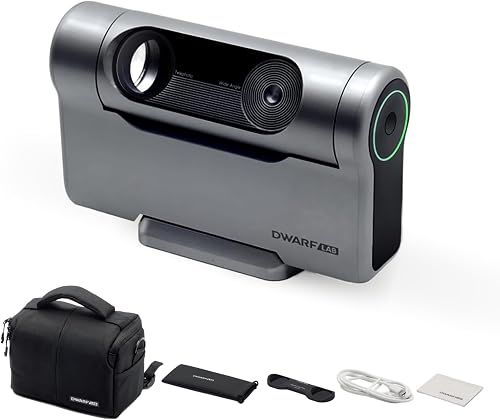
DWARF 3 Smart Telescope
- About 3 lb (1.35 kg), per the listing
- Telephoto and wide-angle dual lens
- App control with auto-tracking
- Box includes a magnetic filter and carry bag
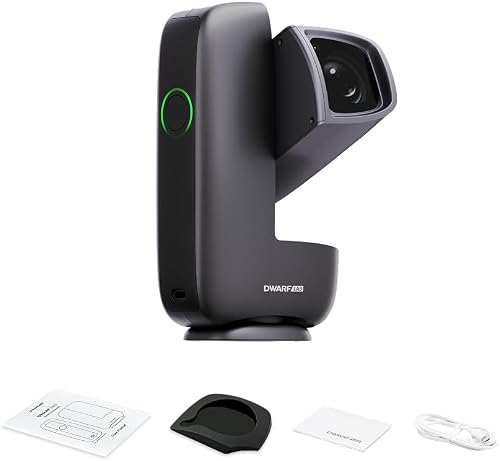
DWARF mini Smart Telescope
- 1.85 lb (840 g), per the listing
- Sony IMX662 sensor
- EQ mode; single exposures up to 90 seconds
- Built-in light pollution filters
Head to head: Seestar S30 vs DWARF 3.
Unistellar Odyssey
The biggest aperture here: an 85 mm mirror at f/3.9, a 5,000+ object catalog, 5 hour battery and a limiting magnitude of 17.2, per Unistellar. It's app-only; the Odyssey Pro adds an eyepiece. Unistellar's listing also mentions NASA and SETI citizen-science campaigns.
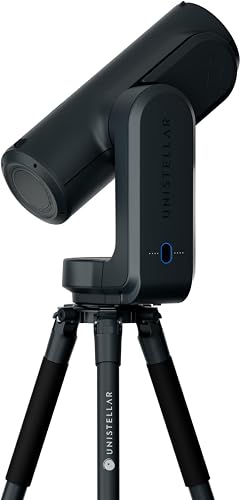
Unistellar Odyssey Smart Telescope
- 85 mm f/3.9 (320 mm), per the listing
- App-only viewing; no eyepiece
- Motorized alt-az GoTo; up to 5 h battery; 64 GB storage
- 4 kg scope plus 2.5 kg tripod
Honest limits
- Light pollution: ZWO says its filter lets the Seestar S50 shoot deep-sky objects "even in city," but "if we want to get good enough results, we still need to go to a dark site."
- Exposure length: on alt-az mounts, field rotation limits exposures; ZWO caps the S50 at 10 seconds in that mode. EQ modes allow longer subs.
- Sun: ZWO says pointing the Seestar at the Sun is "strictly prohibited" without its solar filter installed. Follow the maker's instructions.
Want to use your own camera instead?
A star tracker lets a regular camera take long exposures of the Milky Way. See star trackers.
FAQ
What is a smart telescope?
Telescope, camera and mount in one, run from an app.
Can you look through one?
Usually no; some Unistellar models add an eyepiece.
Do they work in the city?
Better with filters, but dark sites still help.